



Introduction
Costly gym memberships or rooms with exercise machines are not necessary to be fit. In fact, some of the best exercises involve little more than your body weight. Body weight exercises are a great way to get fit, no matter if you’re busy, traveling, working at home, or just prefer working out from the comfort of your own home. They work great for beginners and can be easily adapted for advanced fitness buffs. Best of all, no special equipment is required, and very little space is needed; these exercises can be done almost anywhere. It’s important to be consistent, not perfect. 20-30 minutes of consistent exercise daily can help improve your health. Combined with a balanced diet and quality sleep, home workouts can become an important part of a healthy lifestyle.
Benefits of Home Workouts
There are a number of benefits to bodyweight exercise other than convenience.
The advantages of some of the largest include:
- No membership necessary for the gym.
- No costly equipment required
- For the first time, it is suitable for both beginners and advanced users.
- Can be performed virtually everywhere.
- Reduces expenses and delays
- Enhances strength, balance, and flexibility
- Monitors personal weight and takes steps to achieve and maintain healthy weight
Home exercises are easy to do and can be used to achieve a variety of objectives, such as fat loss, muscle endurance, or staying active.
| Benefit | Why It Matters |
| Convenience | Exercise anytime at home |
| Low Cost | No equipment or membership needed |
| Full-Body Training | Works multiple muscle groups |
| Flexibility | Suitable for different fitness levels |
| Time Efficient | Short workouts can still be effective |
Bodyweight Squats
Squats are a great exercise to build lower body strength and enhance balance and mobility.
How to do it:
- Have your feet at shoulder width.
- Lower buttocks like sitting on a chair.
- Chest up and back straight.
- To stand up, push through your heels.
Push-Ups
Push-ups are one of the most effective exercises using body weight to strengthen the upper body.
They target your:
- Chest
- Shoulders
- Triceps
- Core
If you’re new to this, you can do push-ups on your knees until you get stronger.
Lunges
Lunges help strengthen your leg muscles, coordination, and balance. Alternate legs, upper body remains upright, and front knee is aligned over front foot. Recommended: 10-12 repetitions per leg.
Plank
The plank is a great exercise for toning core muscles.
To perform:
- Lie on your elbows and your big toes.
- Maintain good posture.
- Squeeze abdominal muscles.
- Keep back and hips not dropping.
- Start with 20–30 seconds and gradually increase the duration.
Glute Bridges
Glute bridges are used to build strength in the hips, lower back, and glutes, as well as to correct posture. Lying on your back with your knees bent, raise your hips toward the ceiling, press your glutes together and lower your hips down slowly.
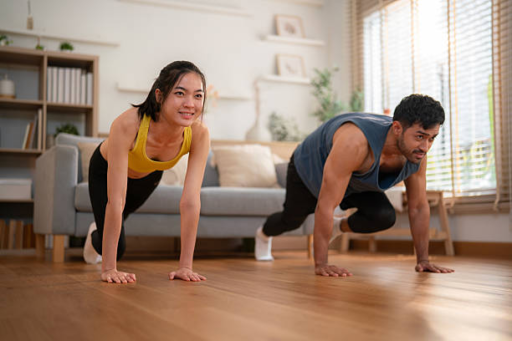
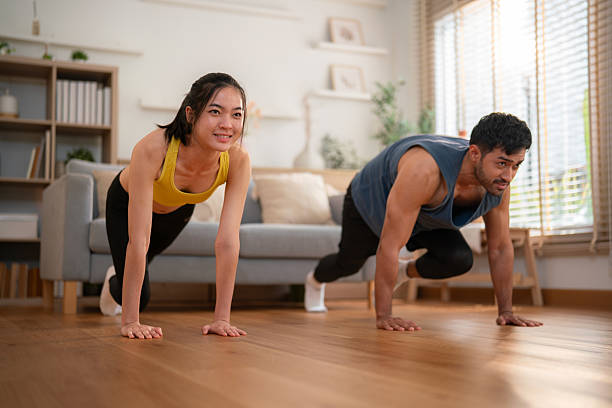
Mountain Climbers
Mountain climbers perform strength training and cardio.
They help improve:
- Heart health
- Endurance
- Core stability
- Coordination
Complete the motion at a comfortable speed and with good form.
Buy health equipment; click here
Jumping Jacks
Jumping jacks are an easy way to get the blood pumping and to get your whole body warm. They enhance cardiovascular fitness and involve both upper and lower bodies. If high-impact movements are not comfortable, make low-impact movements, stepping out, one foot at a time.
Bird Dog
The bird dog exercise is a great core exercise and helps with balance.
How to perform:
- Begin on all fours.
- Extend leg with opposite arm.
- Hold briefly.
- Move back to starting position.
- Switch sides.
Keep movements slow and core stable during the exercise.
Wall Sit
Wall Sits are an excellent workout for your legs that doesn’t involve any equipment. Stand with your back against a wall, lower yourself so that your knees are about 90 degrees and hold. Begin with 20–30 seconds and gradually increase your time.
High Knees
High knees are an excellent cardio activity that is going to assist in increasing your heart rate and help to enrich your legs and core. Pump arms naturally and raise knees towards chest. Change the speed according to your fitness. Sample Beginner Home Workout Routine. For beginners, a simple full-body workout is recommended two to three times a week, with 30-60 seconds of rest between exercises and multiple repetitions (circuits) based on fitness.
Recommend safe and effective home exercises.
To get the best results while reducing the risk of injury, follow these simple guidelines. Warm up for 5–10 minutes before exercising. Don’t worry about speed and emphasis on good form. Take a normal breath during each exercise. Drink water before, during, and after exercise. Cool off with gentle stretching. Start slowly and build up to higher levels of intensity as fitness allows. Pay attention to your body and rest in case of pain or strange sensations. It is more important to be consistent than to have high-intensity sessions infrequently.
| Exercise | Repetitions/Time |
| Bodyweight Squats | 12 reps |
| Push-Ups | 8–12 reps |
| Lunges | 10 reps each leg |
| Plank | 30 seconds |
| Glute Bridges | 15 reps |
| Mountain Climbers | 30 seconds |
| Jumping Jacks | 45 seconds |
| Bird Dog | 10 reps each side |
| Wall Sit | 30 seconds |
| High Knees | 45 seconds |
Frequently Asked Questions
1) Is it possible to gain muscle without using any equipment?
Yes. Pushups, squats, lunges, and planks are exercises that do not require any equipment and can help build strength and muscle endurance, particularly for beginners. As you get stronger, you can do more repetitions or more challenging variations to keep your muscles challenged.
2) How many times per week should I do it at home?
Adults need a minimum of 150 minutes of moderate exercise per week. Workout at home is strength-based and can be done two to four times a week depending on fitness and recovery.
3) Do home exercises help you lose weight?
Yes. Incorporating exercise into your home routine along with a healthy diet and a calorie deficit can help you lose weight. Combining strength training and cardio is a good way to lose calories while maintaining muscle mass.
4) Do I need to warm up before exercising?
Absolutely. A good warm-up will get your blood flowing to your muscles, help you become more flexible, and prepare you for injury when working out.
Conclusion
Staying active doesn’t have to involve the gym or fancy fitness equipment, as these 10 simple home workouts with no equipment prove. Squats, push ups, lunges, planks, glute bridges and mountain climbers are examples of exercises that offer a whole body workout, increase strength and endurance, flexibility, and overall fitness.Results take time and consistency is the key. Just minor exercise, a few times each week, can help you be healthier and happier. Begin at your level of fitness, emphasizing correct form and slowly ramp up exercise intensity as you get stronger.



Nội dung hay và thực tế. Letco là đơn vị du học Hàn Quốc giàu kinh nghiệm, đồng hành cùng học viên từ A-Z. Ghé letco.vn để được tư vấn miễn phí.