
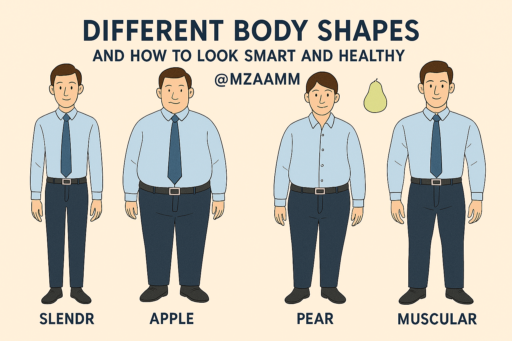
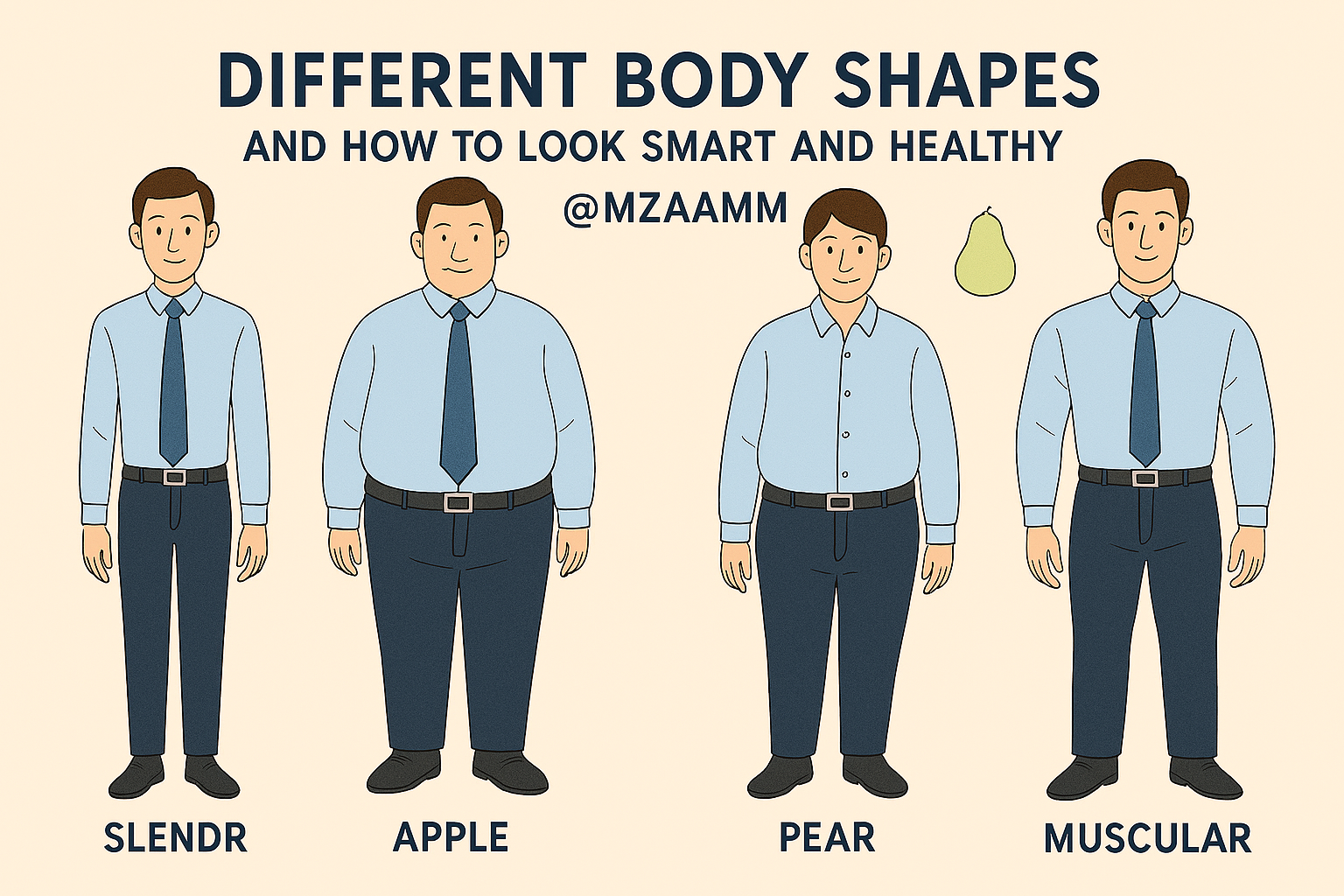

In this article, we will understand the body shape and learn how to maintain a smart and healthy look/appearance which are practical skills that help you choose right clothing according to your body shape. Plan fitness routines, and build nutrition strategies that suit your unique structure. This article explains body shape classifications, measurement methods, visual examples, clothing and grooming tips for each shape. Exercise and nutrition plans to improve posture and body composition, and practical monitoring charts and graphs you can use to track progress. The aim is actionable, realistic advice you can apply whether your goal is leaning out, building muscle, improving posture, or simply looking polished and healthy.
Overview of Body Shapes
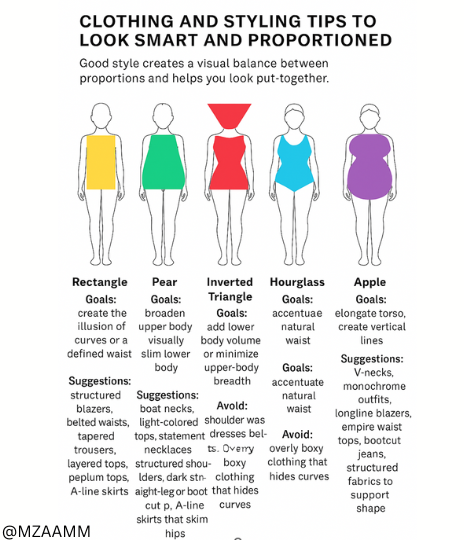
Below image of Body shape refers to the distribution of skeletal frame, muscle, and fat across the torso, shoulders, waist, and hips. While everybody is unique, common categories simplify guidance for clothing, fitness, and posture. The major conventional body-shape types are mentioned in the image below.
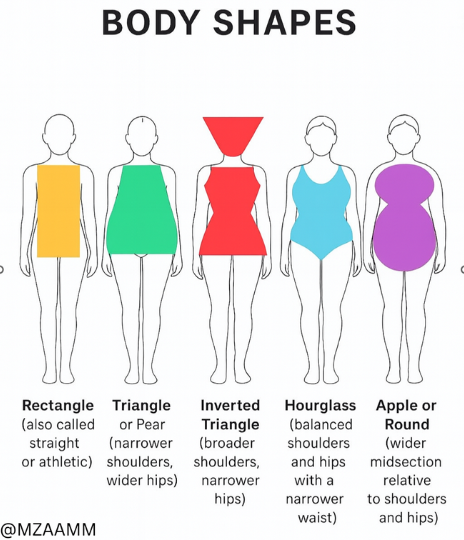
🟨 Rectangle (Straight/Athletic) – shoulders, waist, and hips are similar in width
🟩 Triangle or Pear – narrower shoulders, wider hips
🟥 Inverted Triangle – broad shoulders, narrower hips
🟦 Hourglass – balanced shoulders and hips with a defined waist
🟪 Apple or Round – wider midsection compared to shoulders and hips
*Each shape can combine with different proportions of muscle and fat, so recommendations are always customizable.
How to Measure Your Body Shape?
Accurate measurements let you classify your shape and track change over time.
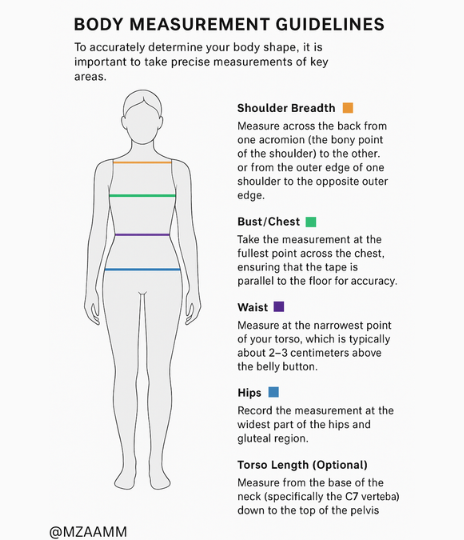
🟧 Shoulder Breadth – orange line across the shoulders
🟩 Bust/Chest – green line across the fullest part of the chest
🟪 Waist – purple line at the narrowest point of the torso
🟦 Hips – blue line at the widest part of the hips/gluteal region
*Torso Length (optional)—from the base of the neck (C7 vertebra) to the top of the pelvis
Additionally, a male figure version of the same guidelines can be created for broader applicability, with the following notes:
*The chest measurement on the male figure corresponds to the fullest part of the chest, typically measured around the pectoral muscles. All other measurement points remain consistent with the female figure guidelines.
How to use measures?
- Compare shoulder vs hip breadth.
- Shoulders significantly broader than hips = Inverted Triangle.
- Hips significantly broader than shoulders = Triangle/Pear.
- Shoulders and hips within ~5% = Rectangle or Hourglass depending on waist.
- Compare waist to bust and hip.
- Waist significantly narrower (>25% smaller) than hips and bust = Hourglass.
- Waist similar to hips and bust = Rectangle.
- Waist larger compared to hips and bust = Apple.
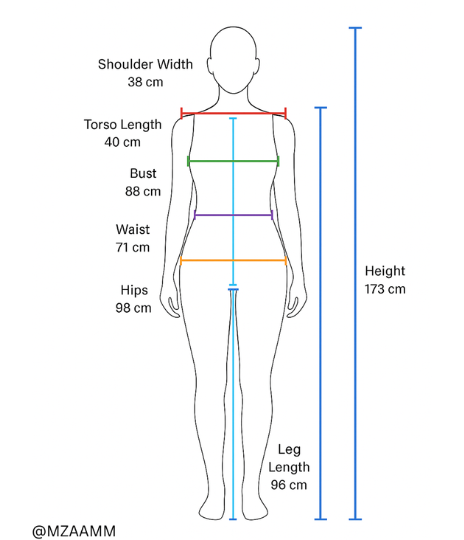
🔴 Shoulder Width – 38 cm
🟢 Bust – 88 cm
🟣 Waist – 71 cm
🟠 Hips – 98 cm
🔵Length: Torso – 40 cm, Leg – 96 cm, Height – 173 cm
Clothing and Styling Tips to Look Smart and Proportioned:
Rectangle
- Goals: create the illusion of curves or a defined waist
- Suggestions: structured blazers, belted waists, tapered trousers, layered tops, peplum tops, A-line skirts
- Avoid: shapeless oversized clothing that hides frame
Pear
- Goals: broaden upper body visually, slim lower body
- Suggestions: boat necks, light-colored tops, statement necklaces, structured shoulders, dark straight-leg or bootcut pants, A-line skirts that skim hips
- Avoid: clingy fabrics around hips, heavy patterns on lower body
Inverted Triangle
- Goals: add lower-body volume or minimize upper-body breadth
- Suggestions: fuller trousers (culottes, wide-leg), dark jackets, skirt textures, v-necklines to narrow chest appearance
- Avoid: shoulder pads, exaggerated shoulder details
Hourglass
- Goals: accentuate natural waist
- Suggestions: wrap dresses, pencil skirts, tailored jackets, high-waisted trousers, belts
- Avoid: overly boxy clothing that hides curves
Apple
- Goals: elongate torso, create vertical lines
- Suggestions: V-necks, monochrome outfits, longline blazers, empire waist tops, bootcut jeans, structured fabrics to support shape
- Avoid: clingy midriff-exposing garments unless comfortable
Grooming and Presentation to Look Smart and Healthy:
A polished appearance is not only clothing — grooming, posture, and small daily habits matter.
- Posture: Stand tall with shoulders back and chin neutral; good posture immediately appears healthier and more confident.
- Skin and hair care: Basic routine — cleanse, moisturize, sun protection, hair trimmed regularly. Healthy skin enhances perceived fitness.
- Fit over fashion: Clothing that fits properly (not too tight, not too baggy) appears smarter than following trends in the wrong size.
- Tailoring: Simple tailoring (hemming trousers, nipping jackets) elevates look.
- Footwear: Clean, well-maintained shoes refine overall appearance.
- Accessories: Use belts, watches, and eyewear to draw lines and balance proportions.
Fitness Principles to Improve Shape and Look Healthy
General fitness goals for sculpting a smart healthy body include:
- Reduce excess body fat for a leaner silhouette (if desired)
- Build or preserve lean muscle for tone and posture
- Improve posture and mobility for a confident stance
- Enhance cardiovascular health for lower resting fat and improved energy
Key training elements:
- Resistance Training (2–5 sessions/week)
- Compound lifts (squat, deadlift, push press, rows) for major muscle groups.
- Isolated work to target weak areas (side raises for shoulder balance, glute bridges for pear shapes).
- Cardiovascular Training (2–4 sessions/week)
- Moderate steady-state or interval training depending on goals.
- 20–45 minutes sessions effective for cardiovascular health and fat loss.
- Mobility & Flexibility (daily 5–15 minutes)
- Stretch hips, hamstrings, chest, thoracic spine to improve posture.
- Posture Work
- Scapular retractions, face pulls, plank variations, and posterior-chain strengthening.
Nutrition Fundamentals to Support a Smart, Healthy Look
Nutrition drives changes in body composition.
- Energy balance: For fat loss, maintain a modest calorie deficit (e.g., 10–20% below maintenance). For muscle gain, a slight surplus (5–10%) supports hypertrophy.
- Protein: Aim for approximately 1.4–2.2 g/kg body weight per day to preserve/build muscle (higher if in a deficit).
- Carbohydrates: Fuel workouts and recovery — adjust around activity.
- Healthy fats: Support hormones and satiety — include nuts, olive oil, fatty fish.
- Vegetables and Fiber: Daily vegetables add micronutrients and satiety.
- Hydration: Adequate fluid intake improves skin, performance, and recovery.
Practical example (male, 75 kg in maintenance):
- Protein: 75–165 g/day (1.0–2.2 g/kg depending on goals)
- Calories: adjust based on goal — deficit for fat loss, slight surplus for muscle gain
Sample Plans and Weekly Templates
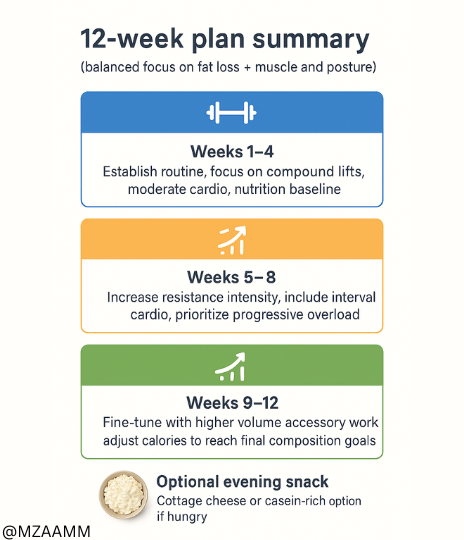
12-week plan summary (balanced focus on fat loss + muscle and posture)
- Weeks 1–4: Establish routine, focus on compound lifts, moderate cardio, nutrition baseline.
- Weeks 5–8: Increase resistance intensity, include interval cardio, prioritize progressive overload.
- Weeks 9–12: Fine-tune with higher volume accessory work, adjust calories to reach final composition goals.
Example weekly training split (intermediate)
- Monday — Upper body strength (bench press, rows, overhead press; accessory rear delt & biceps)
- Tuesday — Lower body strength (squat variations, Romanian deadlifts, calf work)
- Wednesday — Active recovery (mobility, light cardio 20–30 min)
- Thursday — Push hypertrophy (incline work, triceps, shoulders)
- Friday — Pull hypertrophy and core (deadlift variants, pull-ups, planks)
- Saturday — Conditioning (intervals, circuit training) or sports
- Sunday — Rest or mobility
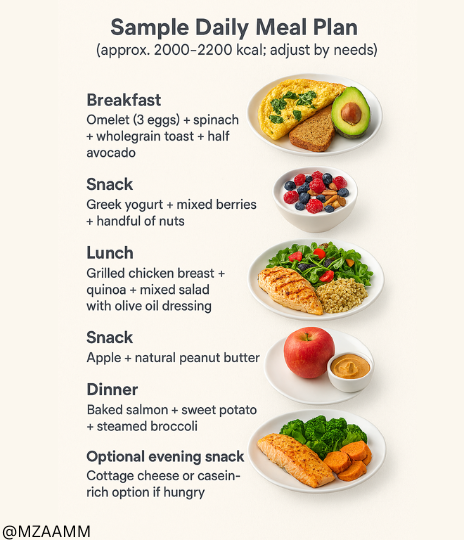
Sample daily meal plan (approx. 2000–2200 kcal; adjust by needs)
- Breakfast: Omelet (3 eggs) + spinach + wholegrain toast + half avocado
- Snack: Greek yogurt + mixed berries + handful of nuts
- Lunch: Grilled chicken breast + quinoa + mixed salad with olive oil dressing
- Snack: Apple + natural peanut butter
- Dinner: Baked salmon + sweet potato + steamed broccoli
- Optional evening snack: Cottage cheese or casein-rich option if hungry
Specific Strategy Recommendations by Body Shape
Rectangle
- Fitness: Build glute and shoulder shape; compound lifts, unilateral leg work, core stability
- Clothing: Belted waists, structured blazers to create curves
Pear
- Fitness: Lower-body strength with glute-ham emphasis to build shape; upper-body hypertrophy to balance (dumbbell bench, lateral raises)
- Clothing: Light, patterned tops; dark bottoms; A-line skirts
Inverted Triangle
- Fitness: Lower-body hypertrophy (squats, leg presses), maintain upper-body strength without overdeveloping traps and delts
- Clothing: Fuller trousers and simple tops; avoid added shoulder volume
Hourglass
- Fitness: Maintain symmetry with full-body compound lifts; focus on waist stability (anti-rotation core)
- Clothing: Clothes that highlight waist — wrap dresses, tailored jackets
Apple
- Fitness: Focus on core strength and posterior chain; cardiovascular conditioning and resistance training to shift body composition
- Clothing: Vertical lines, longline layers to create elongation
Tracking Progress
Consistent tracking helps make objective decisions. Use weekly or biweekly check-ins and simple charts.
1) Weekly Measurement Table
| Week | Weight (kg) | Waist (cm) | Hips (cm) | Shoulders (cm) | Body fat % (estimated) |
| 1 | 82 | 92 | 101 | 44 | 24 |
| 2 | 81.5 | 91.5 | 101 | 44 | 23.8 |
| 4 | 80 | 90 | 100.5 | 44 | 22.5 |
2) Sample ASCII bar chart for weekly weight trend:
| Week | Weight (kg) |
| 1 | 82 |
| 2 | 81.5 |
| 3 | 81 |
| 4 | 80 |
Weight Progress (kg):
- 1: 82 kg |███████████████████████
- 2: 81.5 kg |█████████████████████
- 3: 81 kg |████████████████████
- 4: 80 kg |███████████████████
This summary shows a consistent decrease in weight over a four-week period.
How to read: Bars are proportional to weight value and show trend visually.
3) Body composition progress example (text graph)
- Fat mass: 19.7 kg → 18.0 kg → 16.5 kg
- Lean mass: 62.3 kg → 62.5 kg → 63.5 kg
Interpretation: Losing fat while retaining or gaining lean mass is ideal.
4) Weekly workout adherence chart (table)
| Day | Planned | Completed | Notes |
| Mon | Upper strength | Yes | Increased bench by 2.5 kg |
| Tue | Lower strength | Yes | Felt strong |
| Wed | Mobility | No | Swapped for extra rest |
| Thu | Push hypertrophy | Yes | Good pump |
| Fri | Pull/core | Yes | Added 3×10 chin-ups |
| Sat | Conditioning | Yes | 20 min intervals |
| Sun | Rest | Yes |
Practical Examples and Case Studies
Case A — “Sofia” (Pear shape, wants a slimmer lower body and better posture)
Baseline: Hips > shoulders, moderate fat on thighs, sedentary job. Plan:
- Nutrition: Moderate 300 kcal deficit, high-protein (approx. 1.6 g/kg), vegetables and whole grains.
- Training: 3 sessions/week resistance focusing upper body hypertrophy + 2 sessions emphasizing glutes (hip thrusts, lunges) and moderate cardio (30 min).
- Style: Light-colored, patterned tops and A-line skirts. Tailored jackets to widen shoulder appearance. Outcome after 12 weeks: Reduced hip circumference by 3–4 cm, improved glute firmness, better balance from upper-body training.
Case B — “James” (Apple shape, wants leaner midsection and better energy)
Baseline: Central fat, weak posterior chain, poor posture. Plan:
- Nutrition: Reduce refined carbs, increase protein, create 10% caloric deficit.
- Training: Posterior chain emphasis (deadlifts, rows), core stability (anti-rotation), plus 3 cardio sessions/week including HIIT.
- Style: Vertical lines, V-necks, structured jackets to create elongation. Outcome after 12 weeks: Waist reduced, posture improved, higher energy levels and clothes fit better.
Sample Month-by-Month Progression Plan
First Month — Foundation
- Goal: Habit formation, baseline strength
- Workouts: 3 resistance + 2 cardio + daily mobility
- Nutrition: Track intake, aim for protein target
Second Month — Build and refine
- Goal: Increase load and volume
- Workouts: 4 resistance + 2 cardio; introduce progressive overload
- Nutrition: Adjust calories according to trend
Third Month — Consolidate and specialize
- Goal: Emphasize areas for visual balance
- Workouts: Focused accessory work for weaker regions; maintain cardio
- Style: Apply tailoring and wardrobe changes
Measuring Success Beyond Weight
Weight alone is limited. Useful metrics:
- Circumference changes (waist, hips, thighs)
- Strength gains (e.g., squat, deadlift, pull-up improvements)
- Clothing fit (how a jacket or jeans sit)
- Energy and sleep quality
- Resting heart rate and recovery
- Self-confidence and posture
Common Mistakes and How to Avoid Them
- Chasing quick fixes: Avoid severe caloric restriction; it compromises muscle and skin elasticity.
- Ignoring posture: A rounded posture undermines clothing fit and perceived fitness.
- Overemphasizing one area: Balance resistance and cardio to avoid disproportionate development.
- Not tracking progress: Without objective measures, small but meaningful changes are missed.
Tools and Metrics to Track Progress
- Tape measure and mirror for visual assessments
- Scales with body-fat estimates (for trend use, not absolute)
- Strength log for workouts
- Weekly photos (consistent lighting and posture) for visual comparison
- Simple spreadsheet to track weight, circumference, and workouts
Example Tracking Template (copy into a spreadsheet)
- Columns: Date; Body weight (kg); Waist (cm); Hips (cm); Shoulders (cm); Chest (cm); Body fat %; Training notes; Nutrition notes
- Frequency: Weekly or biweekly
Quick Reference Checklists
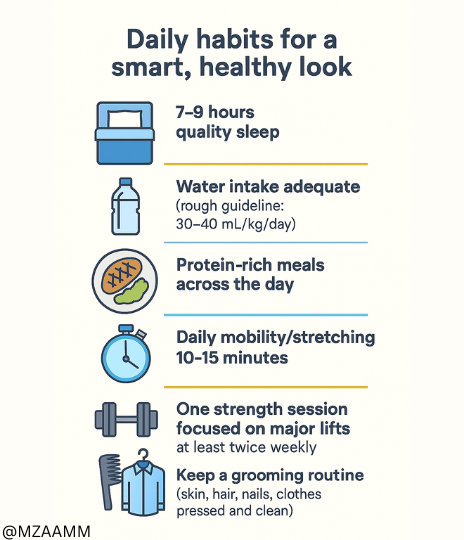
Daily habits for a smart, healthy look
- 7–9 hours quality sleep
- Water intake adequate (rough guideline: 30–40 mL/kg/day)
- Protein-rich meals across the day
- Daily mobility/stretching 10–15 minutes
- One strength session focused on major lifts at least twice weekly
- Keep a grooming routine (skin, hair, nails, clothes pressed and clean)
Weekly checklist
- 3–5 workouts (mix of resistance and cardio)
- 1–2 tailored clothing or fit checks
- 1 rest day with active recovery
- Progress photo and measurement once weekly or fortnightly,
you can create graphs or spread sheet to note down your weekly diet plan and body measurement on it.
- Weight vs Time line graph — weekly points joined to show trend.
- Waist and Hip circumferences plotted together to show silhouette change.
- Body fat % and lean mass stacked bar chart — fat in one color, lean mass in another to visualize recomposition.
- Workout adherence heatmap — days vs weeks colored for completed sessions.
Simple formula to calculate percent change:
- Percent change = ((new value – old value) / old value) × 100
Example:
- Waist from 92 cm to 88 cm → ((88–92)/92) × 100 = −4.35% (a 4.35% reduction)
Closing Summary
Understanding your body shape gives practical advantages: you choose clothes that flatter, prioritize training that corrects imbalances, and follow nutrition plans that support the look you want. A smart, healthy appearance results from consistent habits: quality sleep, moderate progressive resistance training, purposeful cardiovascular work, adequate protein and balanced calories, and grooming and posture care. Use simple tracking tools — tape measures, weekly photos, strength logs, and small charts — to stay objective, adjust plans, and celebrate progress.









В обзорной статье вы найдете собрание важных фактов и аналитики по самым разнообразным темам. Мы рассматриваем как современные исследования, так и исторические контексты, чтобы вы могли получить полное представление о предмете. Погрузитесь в мир знаний и сделайте шаг к пониманию!
Ознакомиться с деталями – https://vivod-iz-zapoya-2.ru/