



Introduction
Early math does not need to feel like a lesson. For young children, it can be part of play. Simple games can help children count objects, recognize numbers, compare sizes, notice patterns, and solve basic problems while they are having fun. Research from the National Association for the Education of Young Children shows that playful math activities can support early mathematical learning and help children build confidence with numbers.
This is why fun math games for early learners can be useful at home and in preschool classrooms. A child can learn counting while moving toy cars. They can learn shapes during a scavenger hunt. They can practice simple addition with blocks. These activities use common items and do not need costly toys or complex worksheets.
The goal is not to make young children memorize many math facts. The goal is to help them understand numbers and see how math works in daily life. Here are 10 simple math games that parents and teachers can try with young learners.
Number Hunt
A number hunt is one of the easiest early math activities for preschoolers. Write numbers from 1 to 10 on small pieces of paper and place them around a room. Ask the child to find each number and say it aloud. For a greater challenge, ask the child to put the numbers in the correct order after finding them.
You can also ask questions such as “Which number comes after 5?” or “Can you find number 8?” This game helps children recognize numbers and understand number order. It also turns learning into an active task.
Count the Toys
Children often have many toys around them. Use this simple situation as a counting game for kids. Put a few toy cars, animal blocks, or dolls on the floor. Ask the child to count them one by one. Then add one more item and ask how many there are now. For example, place five toy cars on the floor. Ask the child to count them. Add another car and ask the child to count again.
- Helps children practice basic counting skills.
- Teaches children to recognize numbers and quantities.
- Introduces simple addition through play.
- Helps children compare more and fewer.
- Builds early math confidence through everyday toys.
You can make the game more interesting by asking comparison questions. Ask “Which group has more?” or “Which group has fewer?” These questions help children understand quantity instead of only saying numbers from memory.
Shape Scavenger Hunt
A shape scavenger hunt is a fun way to teach shapes for preschoolers. Choose a few basic shapes such as circles, squares, triangles, and rectangles. Ask children to look around the house or classroom for objects that match each shape. A plate may look like a circle. A window may look like a rectangle. A block may have a square face.
You can give children a simple challenge. Ask them to find three circles or two rectangles. When they return, ask them to explain why each object belongs to that shape. This activity connects math with the real world.
Build a Number Tower
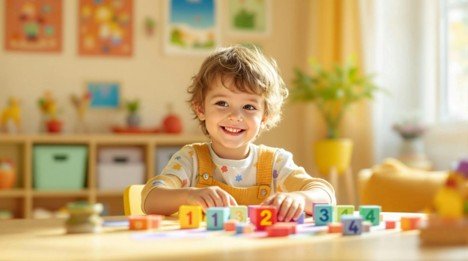
Blocks are excellent tools for learning numbers through play. They allow children to touch, move, stack, and compare objects while learning basic math ideas. Write numbers from 1 to 10 on small cards. Let the child choose one card. The child then builds a tower using the same number of blocks.
If the card shows 4, the child builds a tower with four blocks. If it shows 7, the child builds a tower with seven blocks. After several rounds, compare the towers and ask which tower is taller and which is shorter. Ask how many blocks one tower has compared with another.
Pattern Train
Patterns are an important part of early math learning. You can create a simple pattern using blocks, beads, buttons, or toy cars. For example, make a pattern with red and blue blocks. Place them like this: red, blue, red, blue. Ask the child what should come next.
Once the child understands the basic pattern, make it harder. Try a pattern such as red, red, blue, red, red, blue. You can also let the child create a pattern for you to solve. This makes the activity more social and gives children a chance to think about how patterns work.
Roll and Count
A die can become a simple learning tool. Give the child one die and ask them to roll it. After the die lands, ask the child to count the dots. The child can then collect the same number of blocks or buttons. For example, if the dice shows six dots, the child takes six blocks. Repeat the game several times.
Older preschoolers can use two dice. Ask them to count the dots on both dice and find the total. This creates an easy introduction to simple addition for preschoolers without making the activity feel like formal schoolwork. The activity can also teach turn-taking and following simple game rules.
Sort It Out
Sorting is another useful preschool math activity. Give children a collection of safe everyday objects such as blocks, buttons, toy animals, or colored paper pieces. Ask them to sort the objects by color. After they finish, ask them to sort the same objects by size or shape.
Then ask questions about the groups. Which group has the most objects? Which has the fewest? Are there two groups with the same number? This simple activity helps children compare objects and notice their features. It also introduces early ideas about grouping and data.
Number of Parking Lot
Draw several parking spaces on a piece of paper. Write one number in each space from 1 to 10. Give the child small toy cars. The child must place the correct number of cars in each space. For example, the parking space marked 3 needs three cars. The space marked 6 needs six cars.
You can make the game harder by asking children to compare two parking spaces. Ask “Which space has more cars?” or “How many more cars does this space need to have six?” This game combines number recognition, counting, and comparison. It can be especially useful for children who enjoy vehicle toys.
Math Treasure Hunt
Create a small treasure hunt with simple math clues. Give the child instructions such as “Find two round objects” or “Bring me five blocks.” You can also use simple number clues. Say “Find something with the number 4 on it.” Another clue could ask the child to bring three small objects.
The game keeps children moving while encouraging them to use math in real situations. Young children often learn well when they can connect an idea with something they can see and touch. Playful learning can be especially useful because children remain active participants rather than simply receiving information from an adult.
Snack Math
Food can turn into a quick math game. During snack time give children a small number of safe food pieces such as crackers, fruit pieces, or cereal. Ask them to count their pieces.
Then ask simple questions:
- Can you count five crackers?
- How many do you have now?
- If you eat one, how many are left?
- If I give you two more, how many will you have?
Keep the questions suitable for the child’s age and ability. The purpose is to build understanding through a familiar daily activity.
Download Multiplying Math Worksheet
FAQs
Q1. What are fun math games for early learners?
Fun math games for early learners are simple play-based activities that help children practice counting, numbers, shapes, patterns, sorting, and basic problem-solving.
Q2. What math games are best for preschoolers?
Number hunts, counting toys, shape scavenger hunts, block towers, pattern games, dice games and sorting activities are good choices for preschoolers.
Q3. How can I teach math to my child through play?
Use everyday toys and objects for simple counting, sorting, comparing, and pattern activities. Keep the games short and let your child take part in solving the problems.
Q4. How do math games help young children?
Math games help children develop number recognition, counting, comparison, pattern recognition, logical thinking, and early problem-solving skills enjoyably.
Q5. Can everyday objects be used for preschool math activities?
Yes. Blocks, toys, buttons, paper, food pieces, and other safe household items can be used for counting, sorting, shapes, patterns, and simple addition games.
Buy Math Workbook Ages 5–7: 200 Essential Math Lessons
Final Thoughts
Fun math games for early learners can turn ordinary play into useful learning time. Number hunts, counting games, shape searches, block towers, pattern games, and simple treasure hunts can help children develop early math skills in a relaxed way. Parents and teachers do not need expensive materials. Blocks, toys, food pieces, paper cards, and everyday objects can become learning tools.
Most importantly, keep the experience positive. Let children ask questions, make mistakes, and try again. When math feels like play, children can build useful skills while also developing confidence and curiosity.
Early math is not only about learning numbers. It is about helping children understand quantity patterns, shapes, measurement, and simple problem-solving. With the right games these ideas can become a natural part of everyday childhood.